
Updated 24 January 2026
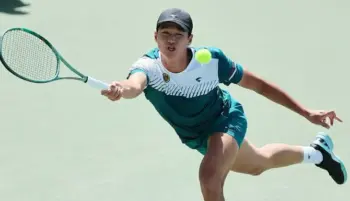
Stan Wawrinka is a legend in the game with 16 ATP titles and now into his last year on tour at age 40, he’s still competing with the best on tour. But what is Wawrinka’s tennis racquet?
Stan Wawrinka’s Racquet Setup
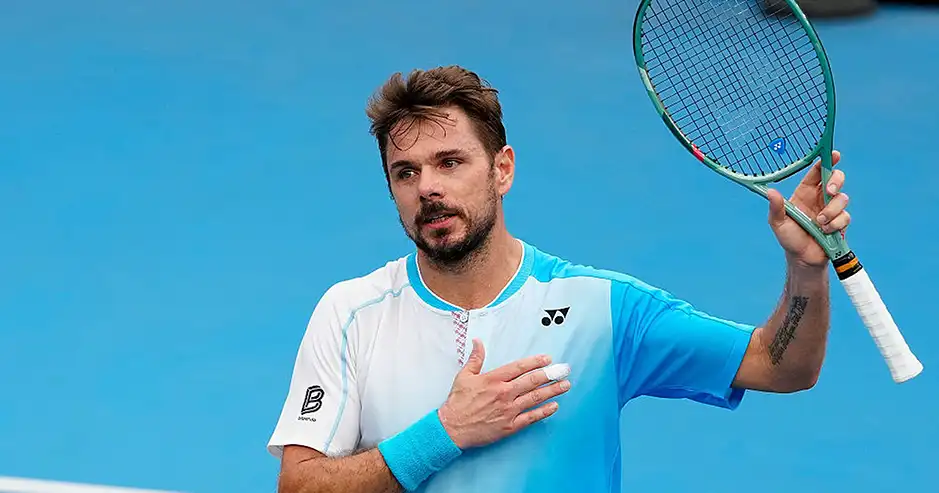
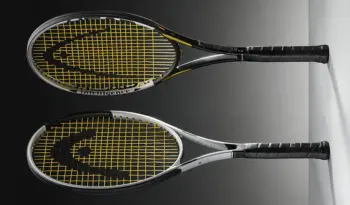
Wawrinka endorses the Yonex Percept 97H and has done for quite a while. I am not sure why Yonex doesn’t have him endorse the Yonex VCORE 95 (click for my review), which is closer to his actual racquet (with loads of lead tape added and a leather grip, of course). But the 330-gram VCORE Pro is the closest racquet when it comes to weight and the ability you need to play with Wawrinka’s specs. Below you find his actual strung specs:
Racquet: Yonex VCORE 95D
Paint Job: Yonex Percept 97H
Headsize: 95 sq. in
Weight: 372 grams (with overgrip)
Balance: 32.2 cm (6 pts HL)
Swingweight: 360
Stiffness: 63 RA
Lead placement: 3 & 9 O’clock
Lead strip length: 5 inches
Grip: 4 3/8
Replacement grip: Yonex leather
Strings: Babolat RPM Blast 16g
String Pattern: 16×20
Tension: 27 kg / 61 lbs mains and 25 kg / 57 lbs crosses
Heavy, powerful and spin-friendly
For a 95 sq inch racquet, the Yonex VCORE 95D is pretty powerful and spin-friendly. The same goes for the new VCORE 95. That is why Wawrinka feels the need to play with a pretty thick and stiff poly at a high tension to keep the power at bay. It is quite interesting that he keeps on using Babolat RPM Blast
You have to be impressed by how fast Wawrinka can swing a racquet with a swing weight of 360. The most impressive change in his game has probably been his movement and his physicality. His time with Magnus Norman has really made him into a “beast” on the court or a “Stanimal” as his fans call him.
Bio and Career
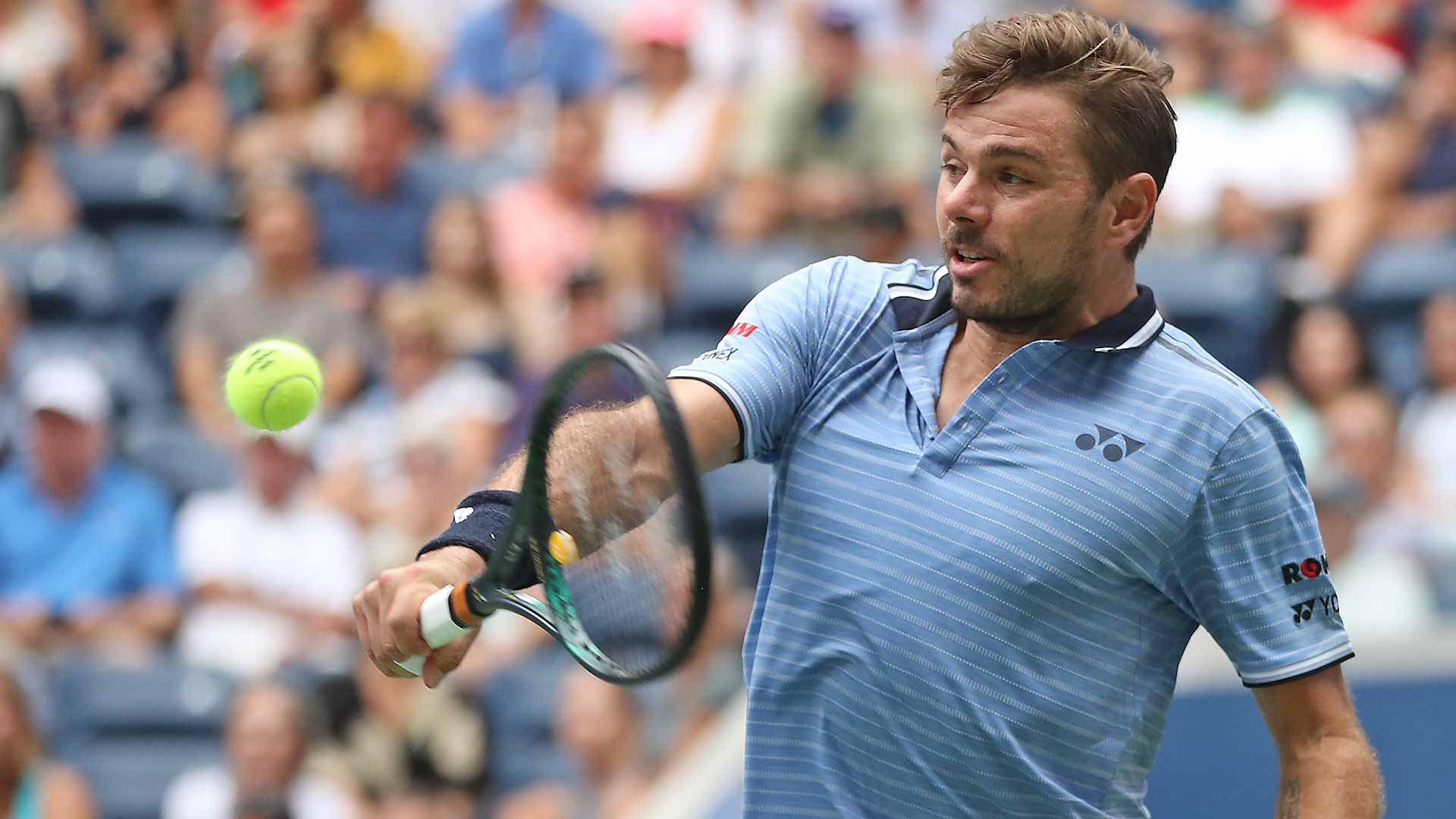
Born on March 28, 1985, in Lausanne, Switzerland, Stanislas Wawrinka grew up on a farm and began playing tennis at age eight. Stan’s rise was then a product of slow, methodical improvement.
- Junior Success: He made his mark early by winning the 2003 Junior French Open, signaling his natural affinity for the red clay.
- Turning Pro: Wawrinka turned professional in 2002. For the first decade of his career, he was a solid Top 20 player but often lived in the massive shadow of his compatriot, Roger Federer.
- First Title: He captured his first ATP singles title in 2006 at Umag, Croatia, defeating a young Novak Djokovic.
From “Stanislas” to “Stan”
The narrative of Wawrinka’s career shifted in 2013 when he began working with coach Magnus Norman. He famously tattooed a Samuel Beckett quote on his left forearm: “Ever tried. Ever failed. No matter. Try again. Fail again. Fail better.” True to those words, this led to a legendary three-year peak of his career:
| Year | Achievement | Notable Victim(s) |
| 2014 | Australian Open Champion | Defeated Novak Djokovic (QF) and Rafael Nadal (F) |
| 2015 | French Open Champion | Defeated Roger Federer (QF) and Novak Djokovic (F) |
| 2016 | US Open Champion | Defeated Novak Djokovic (F) |
Wawrinka remains the only player to defeat the world No. 1 in the final of all three of his Grand Slam title wins.
Career Highlights & Team Success
Wawrinka’s trophy cabinet isn’t limited to individual majors. He proved to be a great teammate and a master of the big occasion.
- Olympic Gold (2008): Partnered with Roger Federer to win the doubles gold medal in Beijing, an iconic moment that solidified “Fedrinka.”
- Davis Cup Champion (2014): Played a vital role alongside Federer to secure Switzerland’s first-ever Davis Cup title.
- Masters 1000 Glory: Won the 2014 Monte-Carlo Masters, defeating Federer in an all-Swiss final.
- Ranking: Reached a career-high of World No. 3 in January 2014.
Playing Style
Wawrinka’s game is built on heavy baseline hitting. While his serve and forehand are world-class, it is his one-handed backhand that most tennis fans talk about. Capable of generating extreme pace and topspin, he can hit winners from deep behind the baseline.
The Veteran’s Resilience
Following knee surgeries in 2017 and 2021, many expected Wawrinka to retire. However, his love for the game has kept him on tour well into his late 30s and early 40s. Even as his ranking fluctuated, he remained a “danger man” in any draw, consistently showing that while the legs might be slower, the power remains undiminished.


hi this is Eric. Is there any way to determine swing weight at home?
Hi,
Yes, there is a manual method: http://twu.tennis-warehouse.com/learning_center/howto_swingweight.php